
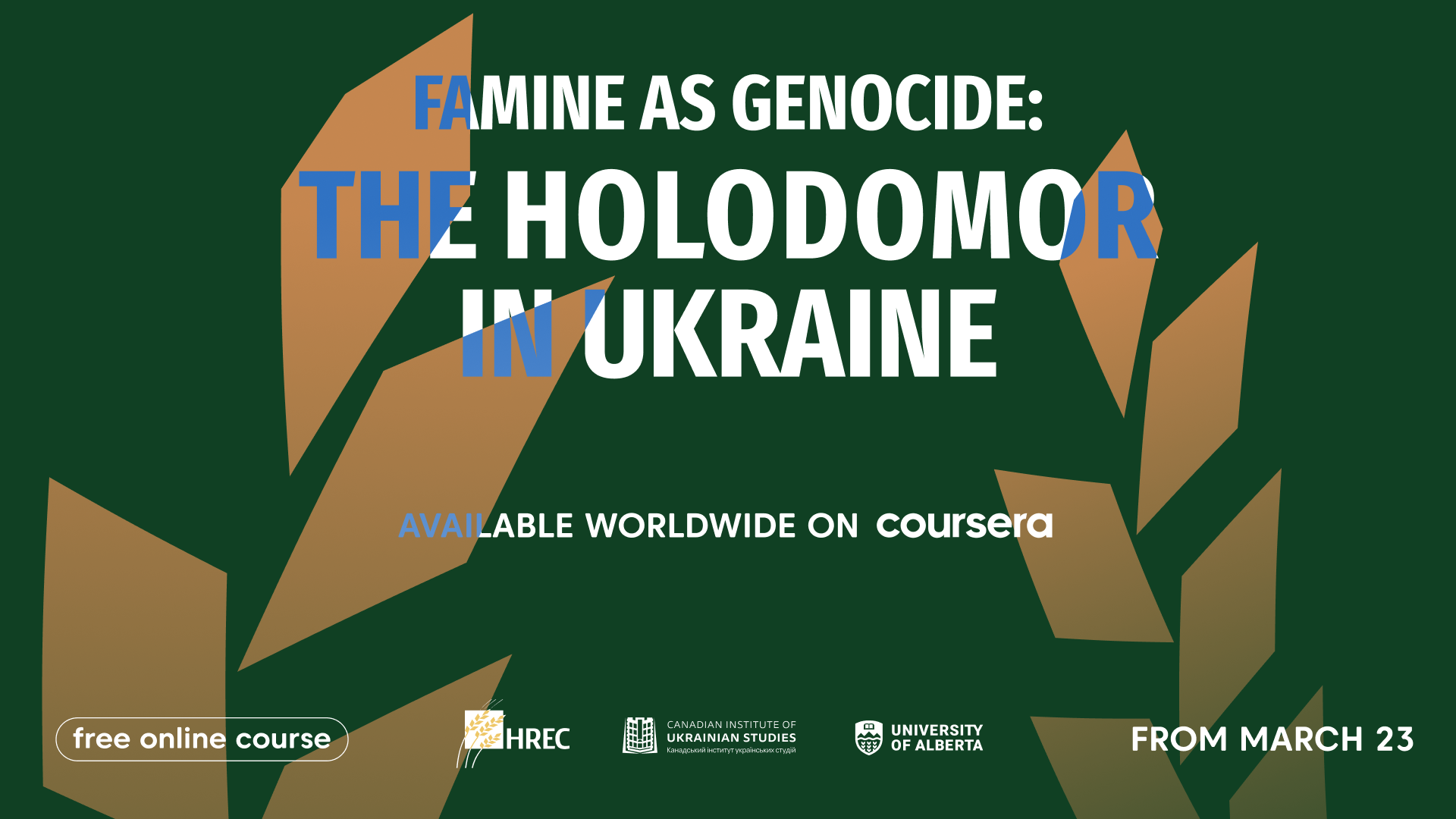
The Holodomor Research and Education Consortium (HREC), an initiative of the Canadian Institute of Ukrainian Studies (CIUS) at the University of Alberta, has announced the launch of a new Massive Open Online Course (MOOC) titled Famine as Genocide in the 20th Century: The Case of the Holodomor. Scheduled to be fully accessible online on March 23, 2026, the 13-module course will be delivered globally on the Coursera platform, offering a vital resource for scholars, students, and the public alike to examine one of the 20th century's most devastating, yet understudied, episodes of mass violence.
The course addresses a profound paradox: the famines of the 20th century occurred in an age of unprecedented global food abundance. As the case of the Holodomor illustrates, the catastrophic 20th-century famines were not merely humanitarian disasters but were often forms of political violence that targeted marginalized populations in the pursuit of transformative political projects.
The 1932-33 famine in Soviet Ukraine—the Holodomor—represents the epitome of this kind of violence. Famine as Genocide in the 20th Century explores the Holodomor through an interdisciplinary lens, engaging with famine studies; Soviet , Ukrainian, and global history; colonial and genocide theory; as well as memory studies. Organized by the Holodomor Research and Education Consortium at the University of Alberta, the course draws on decades of international research conducted by leading experts.
The course consists of 13 modules, or lessons, that integrate a wealth of recent scholarship related to the Holodomor.The delivery method via the Coursera platform will feature interviews with leading international experts, archival documents, videos and photos, guest lectures, primary and secondary source readings, and scalable assessments.Module topics include “Dying and Living,” which explores the experience of those who suffered the Holodomor; “Ukrainian Cultural Renaissance and the Destruction of Ukrainian Culture,” which looks at the policy of Ukrainianization and its brutal conclusion; “What Did the World Know?” which addresses what the international community knew about the famine at the time it was happening; and modules on the aftermath and longer-term impact of the Holodomor as well as how knowledge of the Holodomor has been preserved and shared over time.
The collaboration between the University of Alberta and Coursera ensures that the course fulfills a dual mandate: While University of Alberta students—specifically through the Department of History, Classics, and Religion—will be able to register for Famine as Genocide in the 20th Century: The Case of the Holodomor, the online course will be accessible to the general public globally at no cost.
Participants will gain knowledge of the Holodomor’s impact on Ukrainian, Soviet, and world history, improve their ability to analyze primary sources and oral history, and develop a critical understanding of Stalinist society.
Crucially, the course compels reflection on the Holodomor's enduring relevance to current political developments in the region and the Russian war on Ukraine, addressing themes like disinformation and ‘fake news’ within the context of historic Russian-Ukrainian relations.
This project is made possible through the dedicated efforts of CIUS and HREC, with generous support from the Helen and Paul Baszucki Family and the Temerty Foundation.
About the Course:
Famine as Genocide in the 20th Century: The Case of the Holodomor is a wide-ranging exploration of the 1932-33 famine in Ukraine. Learners will gain a deep understanding of the Holodomor in the context of other 20th century famines, genocide studies, survivor experience, knowledge dissemination, disinformation and denial, and Ukrainian and Soviet history.
The Holodomor, one of the major tragedies of the twentieth century, became the subject of serious study only since the fall of the USSR. Through an exploration of recent research and through the prisms of colonialism, empire, genocide, famine and food security, (dis)information dissemination, and Ukrainian-Russian relations, Famine as Genocide in the 20th Century: The Case of the Holodomor makes the case that the Holodomor is crucial to understanding Ukrainian, Soviet, European, and world history as well as current events.
This course is offered online in thirteen modules through University of Alberta’s partnership with the platform Coursera through which courses are offered for-credit to UofA students as well as to the general public.