
Fortuitous Find: New Antiquarian Discovery at the SVI Library in Toronto
Thomas M. Prymak (University of Toronto). Originally published in The New Pathway, November 11, 2025. Republished with permission.
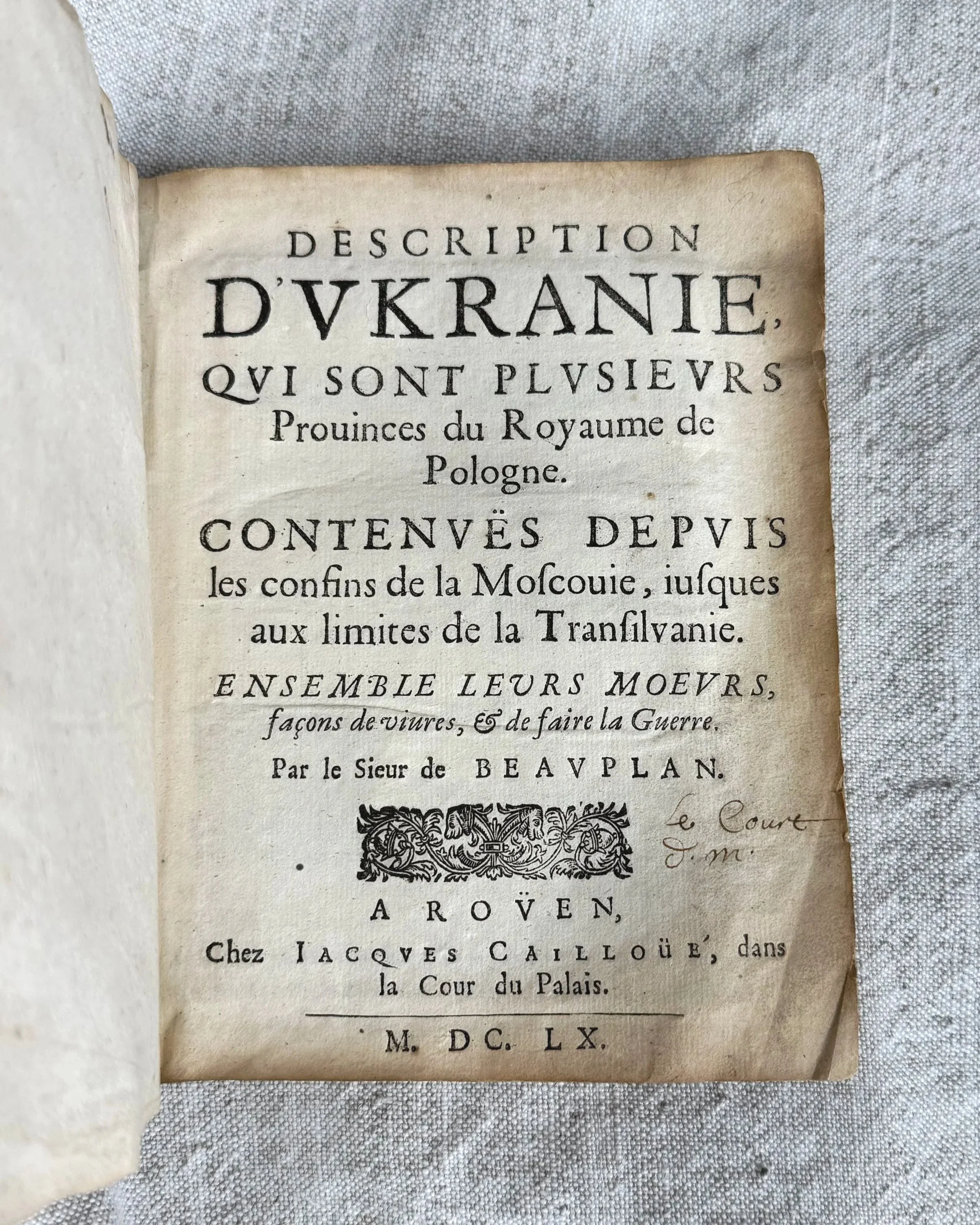
Frontispiece of Guillaume de Beauplan's Description de Vkranie (Description of Ukraine), 1660.
A few weeks ago, I was on one of my frequent visits to the St Volodymyr Institute (SVI) Library in Toronto. I wished to do some work on Ukrainian history and was cheerfully greeted by the new librarian, Anastasia Baczynskyj. For the previous week or two, she had turned to continuing retired librarian Halya Ostapchuk’s work in sorting and processing the numerous donations that the library had recently received. This was no easy task, as the retiring librarian had received two very big and very rich donations, entire private libraries, it seems, at almost the same time. One of these was the lifelong collection of the famed Ukrainian bibliophile, the former editor of Forum: A Ukrainian Review, Andrew Gregorovich. But Anastasia was enthusiastic about her work and her enthusiasm was catchy.
That day, however, was exceptional. She immediately ran up to me and exclaimed, “You will not believe what I have just discovered!” In a pile of old books, papers, and documents in a little-observed corner of a storage room, and at the very bottom of this pile of books and papers, she had come across a carefully boxed and complete, undamaged, original French-language copy of the famous book of Guillaume de Beauplan, the Description d’ Vkranie (Description of Ukraine) published in Rouen in France in 1660!
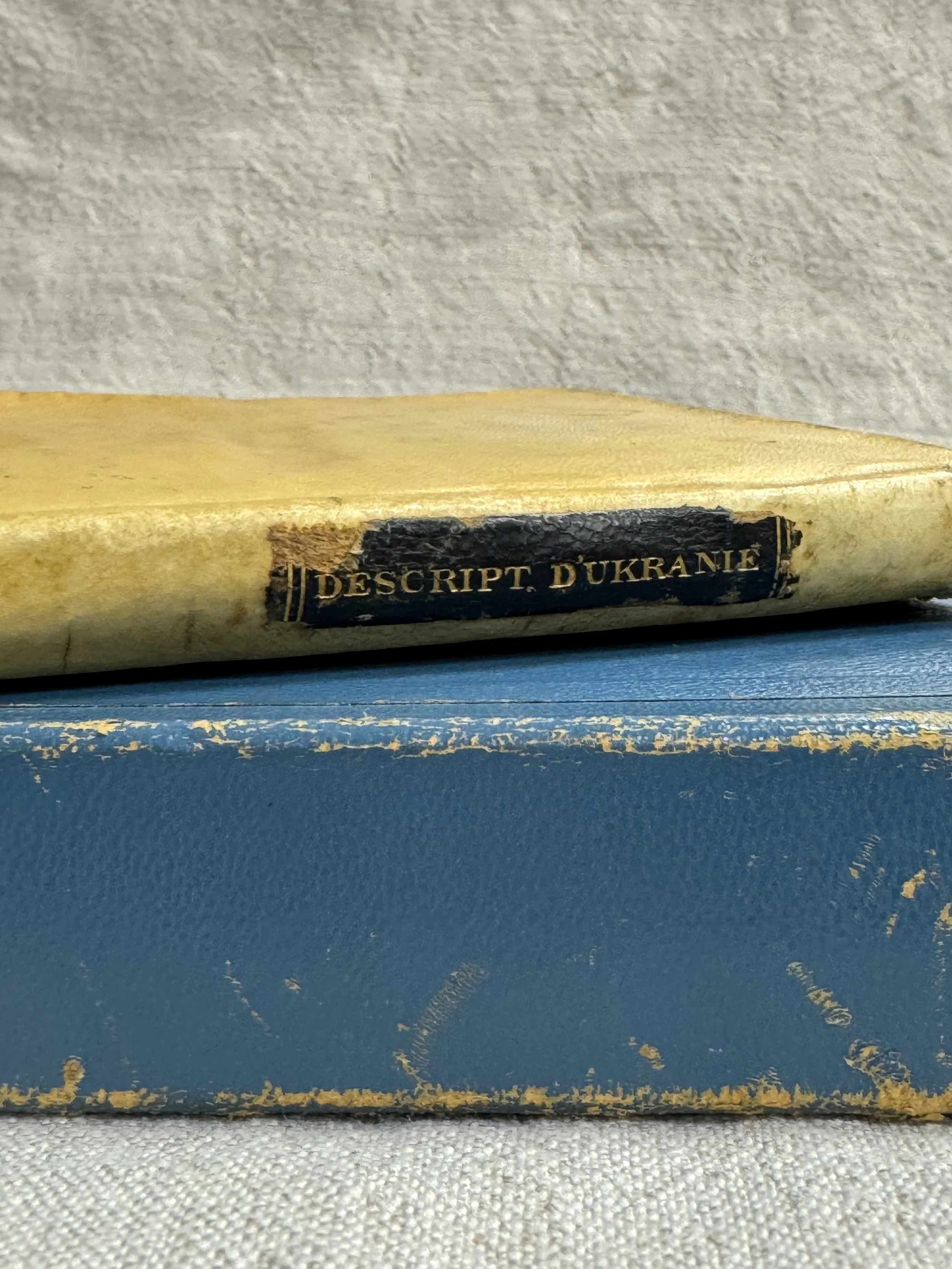
Spine of Guillaume de Beauplan's Description d'Ukraine, 1660.
Interior of clamshell box for Guillaume de Beauplan's Description d'Ukraine, 1660, with bibliographic and critical notes.
The book was adequately bound in a white leather cover, and all the pages seemed to be there, quite readable, and clear. The book was printed on the beautifully durable paper of the seventeenth century, which is immediately recognizable to anyone who has handled very old books. Such books were made from old, washed and bleached cloth, and never wood pulp, which is much more acidic and decays more rapidly. Books printed on paper made from wood pulp, very cheap, only became common much later.
None of the pages of this little volume were in any way stained or severely damaged, and the paper was still quite white with no sign of deterioration, though they were, of course, quite brittle after some three and a half centuries and more on unidentified library shelves, probably in Europe.
The book was accompanied by a note dated September 1985, from one Mr. Eugene Kurdydyk. This Eugene Kurdydyk was a Toronto real estate agent and small-time businessman/trader who engaged in the sale of antiquarian books, maps, and other artifacts, all with some connection to Ukraine and Ukrainian culture. The attached note to prospective readers seemingly indicated that he was an owner of the Beauplan volume and was offering it for sale.
Eugene’s documentation included a second letter, this one to him from a contact who had approached an important antiquarian book expert in France; the latter testified to him in a letter written in French that he had long been searching for an example of Beauplan’s book, complete with its original map included in a pocket attached to the back cover, but all three that he found across his career, even that of the famed Russian art critic Sergei Diaghelev, a founder of the modernist World of Art group, were missing this map.
About the same time that Eugene wrote his covering letter, that is, in the fall of 1985, if I correctly recall, the SVI hosted an exhibit of antiquarian maps from his collection, which I attended. Many of these were beautiful examples of seventeenth- and eighteenth-century cartography, with numerous maps hand-coloured. Over the years, Toronto residents, Christine and Walter Kudryk bought several maps from Kurdydyk and they are preserved to the present day in the very large Walter Kudryk Collection, which is in process of being transferred to a museum in western Canada.
But the new SVI copy, apparently discovered among the numerous old books of Andrew Gregorovich (in that pile of still uncatalogued new acquisitions) had this map attached in such a pocket at the back of the book! Anastasia, who reads French quite easily, immediately recognized the importance of this book and its map, for not only was it now the oldest known book in the SVI Library, but it was also of extreme importance in Ukrainian history, particularly for old Cossack Ukraine.
Astoundingly, the Fisher Rare Books Library at the University of Toronto also holds a copy of this rare book along with three fold-out plates and the map. It contains an Ex Libris of the Château des Espas (Cte Begouen) meaning that this copy was once held by the owners of that old castle in France. But then again, perhaps this is not so surprising as the University of Toronto library system holds one of the richest collections of urainica in the western world. It was built up over about three or four generations of professional librarians from the 1950s on. Those whom I have known included the above mentioned collector Andrew Gregorovich, Bohdan Budurowycz, who was a historian, Mary Stevens, an acquisitions specialist, and presently Ksenya Kiebuzinski, an expert in French-Ukrainian cultural relations, who came to Toronto from the Harvard Ukrainian Research Institute in Cambridge/Boston.
Beauplan was a contemporary of Cossack Hetman Bohdan Khmelnytsky, and the Frenchman was one of the first western Europeans to know Ukraine well and to use the name “Ukraine” in the titles of his books and maps; for he had been an engineer and cartographer in the employ of the King of Poland Władisław IV, and Ukraine was for many years ruled by the Poles, who were afterwards partially expelled by Khmelnytsky’s Cossacks in the Great Wars of 1648-57.
In fact, “Beauplan,” a surname in French meaning something like “beautiful map,” was probably accorded him, or taken on by him, for his pioneering work on Ukrainian cartography or engineering. (He had also designed some important royal fortresses across Ukraine.) His full name, so far as we know, was “Guillaume le Vasseur Sieur de Beauplan.” “Le Vasseur” was probably his original surname; but that was in a century when surnames were still quite malleable for persons of non-noble background. “Vasseur” in French means “vassal” originally a rank somewhat below that of a baron.
The full title page of Beauplan’s book in English translation reads “A Description of Ukraine, Containing several Provinces of the Kingdom of Poland, Lying between the Confines of Muscovy, and the Borders of Transylvania, Together with their Customs, Manner of Life, and How they Manage their Wars, by the Sieur de Beauplan.” So, his definition of Ukraine was quite expansive, extending far beyond the borders of today’s Ukrainian national state. On another level, the name of its most important inhabitants of that time, “the Cossacks,” is missing from this title page but might be what is meant by the “they” (leurs/their) in this title. Inside, however, Beauplan gives much new information about these Cossacks.
Beauplan mostly reported what he himself saw and this included how the Cossacks elected their leaders, how they made war, their relations with the Tatars, how the Tatars took captives from among the common people, and the cruel fate of such people in Tatar captivity. Beauplan also described the customs, manners, and morals of the Cossack people. These included a vivid description of Cossack marriage customs.
****
All this information was copied and disseminated across Europe for the next two hundred years and more. Henceforth, many maps were printed with the title “Ukraine, Land of the Cossacks,” and somewhat later, “Ukraine, Land of the Old Cossacks.”
According to Beauplan specialist A. B. Pernal of Brandon University in Manitoba, in the 1600s, the book itself was translated into Latin, Dutch, Spanish, and English, and in following years was reprinted many times. A particularly important English edition was printed in London in 1744, and a notable French edition was published in Paris in 1861.
(I have originals of both in my private library, acquired earlier, also from Gregorovich’s large collection.)
A Russian translation edited by a certain F. Ustrailov came out St Petersburg in 1832, and it had a great influence upon the Ukrainian National Awakening that was just then in its initial phase. (The poet Taras Shevchenko’s first Kobzar (The Blind Minstrel), or book of poems, was published in 1840.) But the newly discovered SVI Library copy is the original “expanded edition of 1660.” The first (1651) had been much shorter, and of it, only 100 copies were printed.
But the expanded edition now rediscovered in the SVI is more detailed and of much greater historical value. Moreover, on the antique book market, this little book would probably fetch many thousands of dollars. A quick search of Bookfinder.com revealed that none are available today.
Anastasia Baczynskyj, Halya Ostapchuk before her, and the SVI Library are to be congratulated for this important find, which is so very significant for understanding where Ukraine fit onto the map of Europe in the 1600s, what transpired there just before and during Beauplan’s lifetime, and how the country fits into European history today.
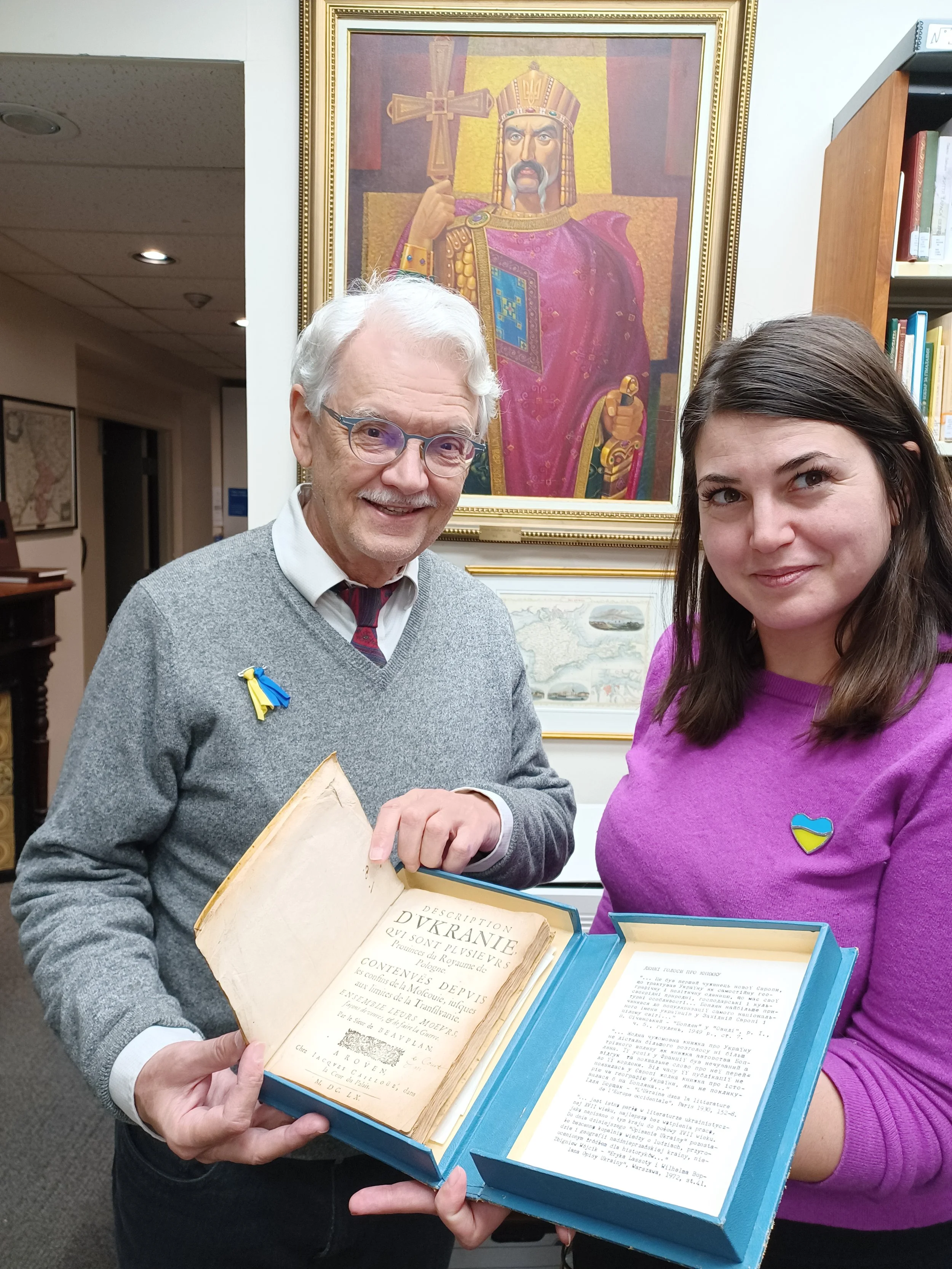
The author with librarian Anastasia Baczynskyj
THOMAS M. PRYMAK, PhD, is a Senior Research Fellow at the Chair of Ukrainian Studies, Departments of History and Political Science, University of Toronto. He is the author of several books and numerous articles and reviews on Ukrainian and Ukrainian Canadian political and cultural history, art history, and philology, including etymology and onomastics (name studies).
