
Not lost in Translation
Anastasia Baczynskyj
“But he doesn’t speak English or Ukrainian.”
“We will use our phones to translate and do our best.”
Mr.S__ was due to come in to look at one of SVI’s most important books, Guillaume de Beauplan’s “Déscription de l’Ukraine”, published in 1651. It is one of only several copies left, and is a key firsthand account of 17th century life in Ukraine. Mr.S__ had heard about it in a local newspaper, and his daughter had been trying to arrange a visit for him for over a month. He was from the far end of Mississauga and she wanted to drive him in for the appointment but our schedules had been too disparate. He had decided he would come by himself by bus - such was his determination to see this important piece of Ukrainian history.
The day had finally come and I was ready. I not only prepared the book, but I also found 17th-century maps and exact photostatic copies of the text. He wasn’t an academic, as I understood, just a man who wanted to learn more about Ukrainian culture. That was enough for me.
He arrived and I knew it wasn’t going to be easy. The gentleman truly spoke no English, French or Ukrainian and he had many questions and started asking them immediately — with great excitement. We had to use several translator apps until we settled into a rhythm where we could understand each other. When we finally sat at the table to see the famous book, his expressions and gestures showed his deep interest. He sat in respectful contemplation as I showed him the book, page by page. He was delighted when I offered to show him several 17th century maps relating to it. It was moving to see his fascination and I asked why he was interested in Ukrainian culture. He sheepishly said that he once wanted to do an exchange when he lived in Beijing as a young man, but it did not turn out. I decided to leave the subject as it looked as if it was slightly painful.
We sat together for over an hour and when I had showed him all I could related to the subject, he bowed and thanked me with such kindness and gratitude I immediately felt the impact the viewing had had on him. He pulled out a wrapped gift and presented it to me. “This gift will help you this year,” I read on the phone. The gift was framed picture of a horse, gilded and galloping, on a black background. It was beautiful. In the Chinese zodiac, 2026 is the year of the horse, he explained, and he showed me prepared slides on his phone of all the things that this picture would attract. The gift was his sincere wish that we would have swift success, initiative, strong leadership and courage.
I almost cried. This older gentleman came to the SVI library, in the middle of winter, from deep Mississauga on several busses, just to learn about our culture, and offered us a piece of his in return. This was a true cultural exchange and I felt the importance of the moment — as a librarian of SVI and for myself personally.
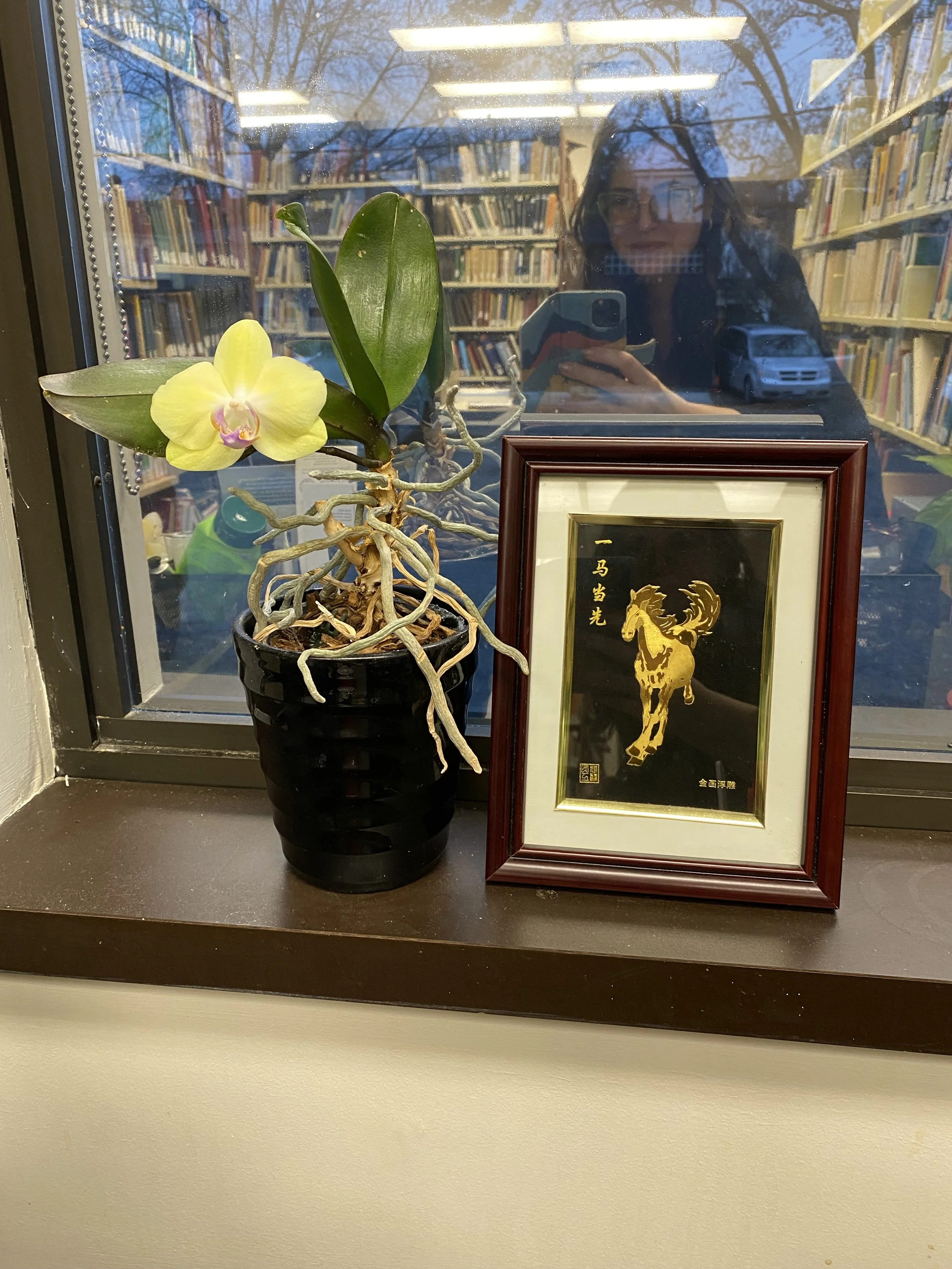
It is for these moments that libraries and librarians exist. To open doors, to sincerely welcome, and to aid in all things to help people access information, no matter the challenges. Not only is helping people learn about our culture the professional thing to do, it is the right thing, and the kind thing to do. Mr. S__ did me one better. He came to look at the book, but was fully prepared and determined to show us great kindness as well. It was a powerful encounter.
Before we said our final goodbyes, he asked whether we would be kind enough to invite him when there are theatre performances. He really liked theatre, he explained. It struck me that the exchange he had mentioned may have been a theatre exchange.
“Of course,” I said. “I will invite you personally. I am looking forward to seeing you at the library again, Mr. S_!”
And I meant it.
Anastasia Baczynskyj
Librarian, SVI
