
Paint, Porcelain, and Pages: A Living Archive of Natalka Husar
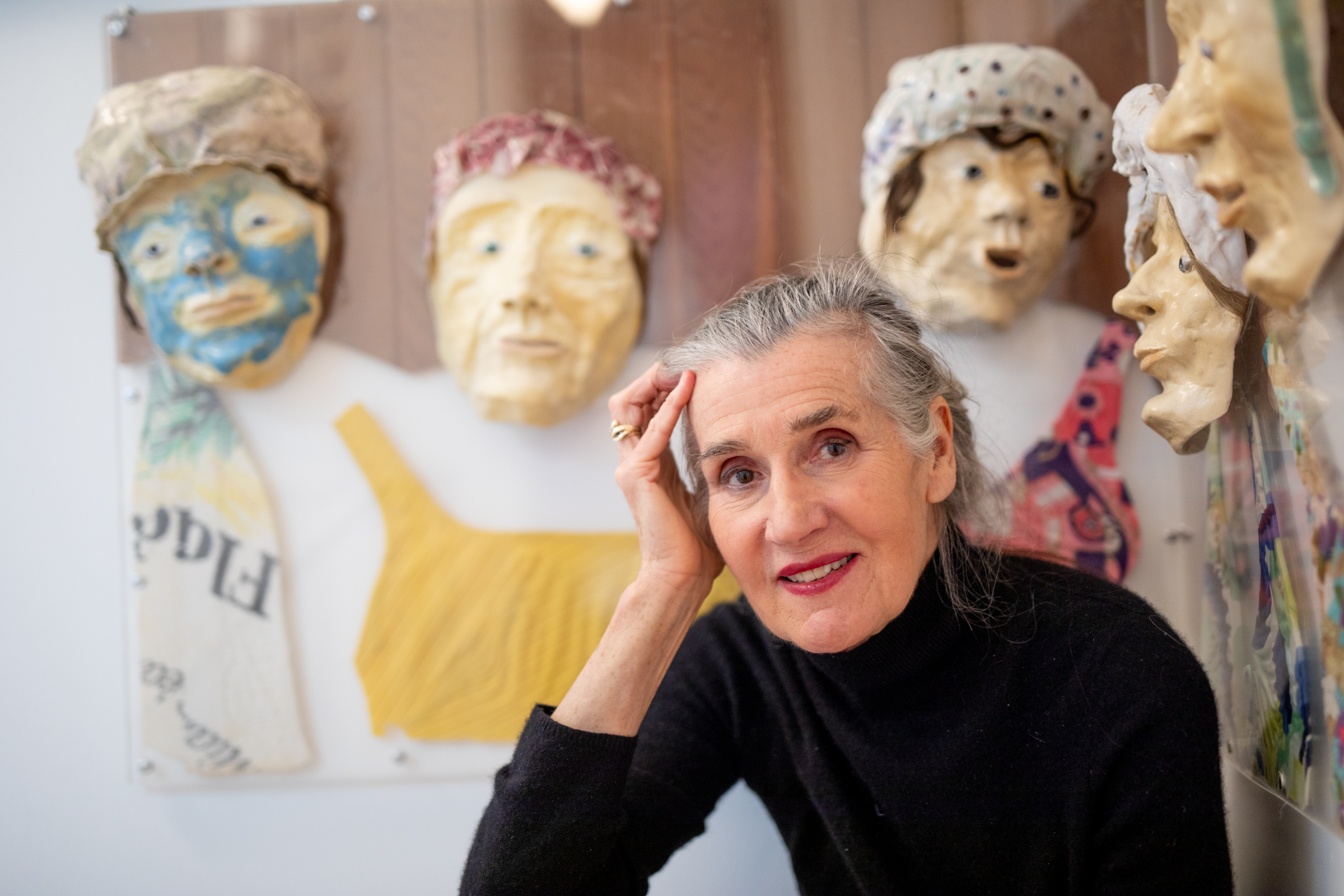
Natalka in front of her piece Sauna Ladies from Faces Facades (1980). Photo by Zahra Saleki.
Oksana Hawrylak
Born in New Jersey in 1951 to Ukrainian immigrant parents, Natalka Husar graduated from Rutgers University in 1973 before moving to Toronto. Since then, she has exhibited extensively across Canada and internationally, with her work represented in major public collections such as the National Gallery of Canada and the Art Gallery of Ontario, where her painting Torn Heart (1994) is currently on display. Her ceramics are also now on permanent display at the Gardiner Museum. In the last 15 years, she has collaborated on publications with Rodovid Press in Ukraine. Her practice draws on Ukrainian culture and history, the émigré experience, and femininity. Most recently, Husar’s early connection to Ukraine resurfaced in It Takes Three to Tango (Rodovid, 2024), a book compiling over 550 illustrated letters between a young Husar and Lviv artist Ivan Ostafiychuk. What began as a staged romance evolved into a layered exchange that blurs fiction and reality, offering a portrait of an era and the imagination as a bridge across borders.
In the spring of 2024, I met with artist Natalka Husar in her Toronto kitchen over Turkish coffee and home-baked cookies to reflect on nearly 50 years of work—work that speaks to both Ukraine’s ongoing fight for survival and her own place in Canadian art. We talked about the war in Ukraine and what it means to witness it from Canada, geographically distant yet deeply connected to her own culture and life.
Spread out on the kitchen table between us were her catalogues, each a marker in the timeline of her career: Faces Facades (1980); Behind the Irony Curtain (1986); Milk and Blood (1988); True Confessions (1991); Black Sea Blue (1995); Blond with Dark Roots (2001); Aptechka / Burden of Innocence (2009); Husar Handbook (2010); and, most recently, Soaking Wet and on Fire (2023), which accompanied her exhibition at the Gardiner Museum, after which one work from the series was incorporated into the museum’s permanent ground floor display following its extensive renovation. The catalogue places her early ceramics in conversation with recent paintings, revealing their foundational role in her development as an artist.
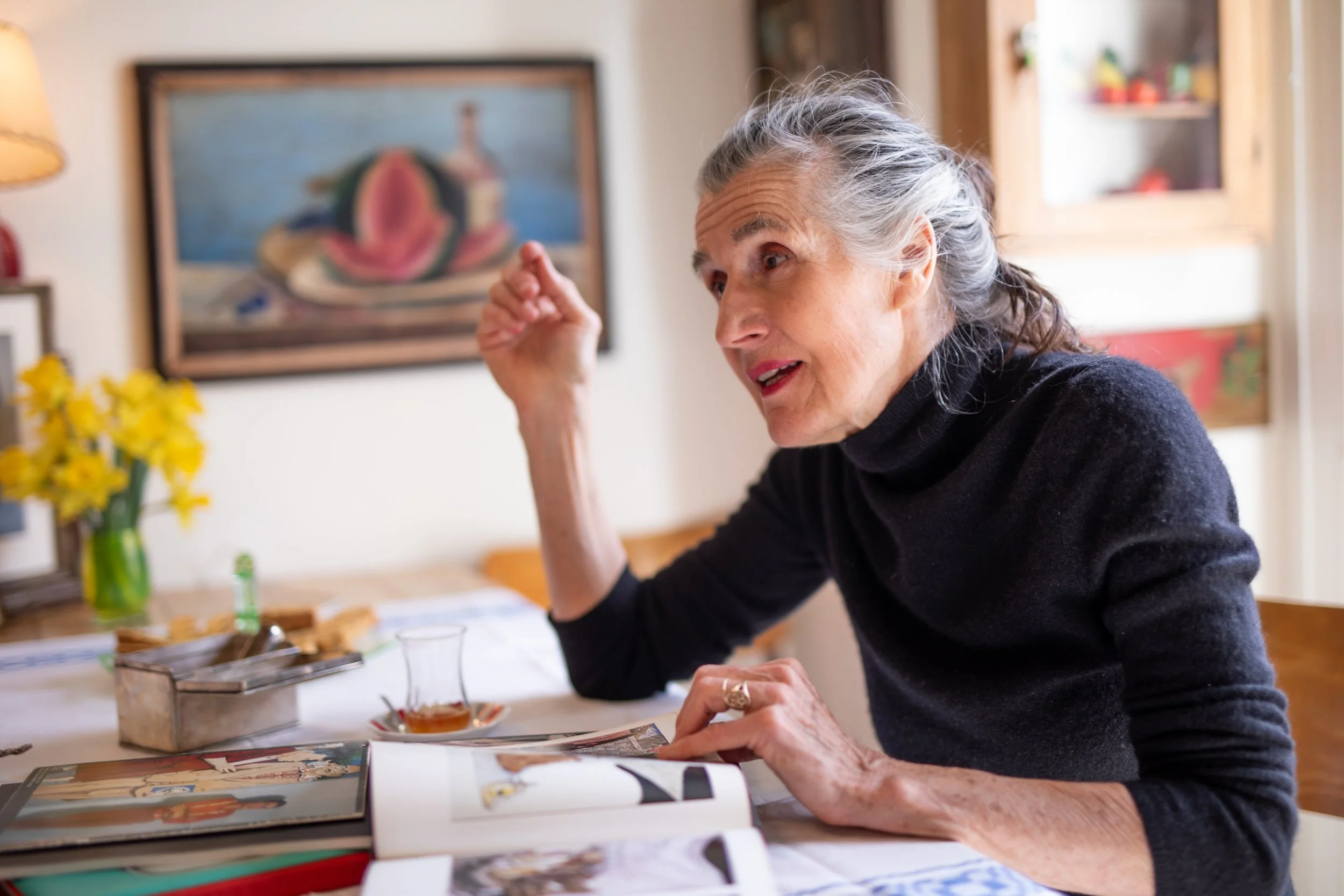
Natalka at her kitchen table. Photo by Zahra Saleki.
More than merely records of her art, the catalogues are artworks themselves. They include essays and reflections from critics and poets, creating a conversation between image and text. They show a transformation in material and format, moving from early self-published, handwritten and hand-bound editions to catalogues that mimic novels, magazines, and vinyl sleeves, and culminating in hand-bound volumes produced in Ukraine. Viewing them in sequence feels like flipping through a time machine, blending the real and surreal into a singular autobiography.
The books trace her career while also revealing a consistent visual language. Husar works across a range of materials and scales, with prominent, larger pieces painted on antique Ukrainian linen. Built through continual revision, her compositions bring together figures, objects, and colour palettes that are repositioned, repainted, replaced, and repurposed over time.
There is an element of play in this process.
“I take what’s happening around me — politics, social stuff — and filter it through my work. It’s my way of recording what’s going on now.”
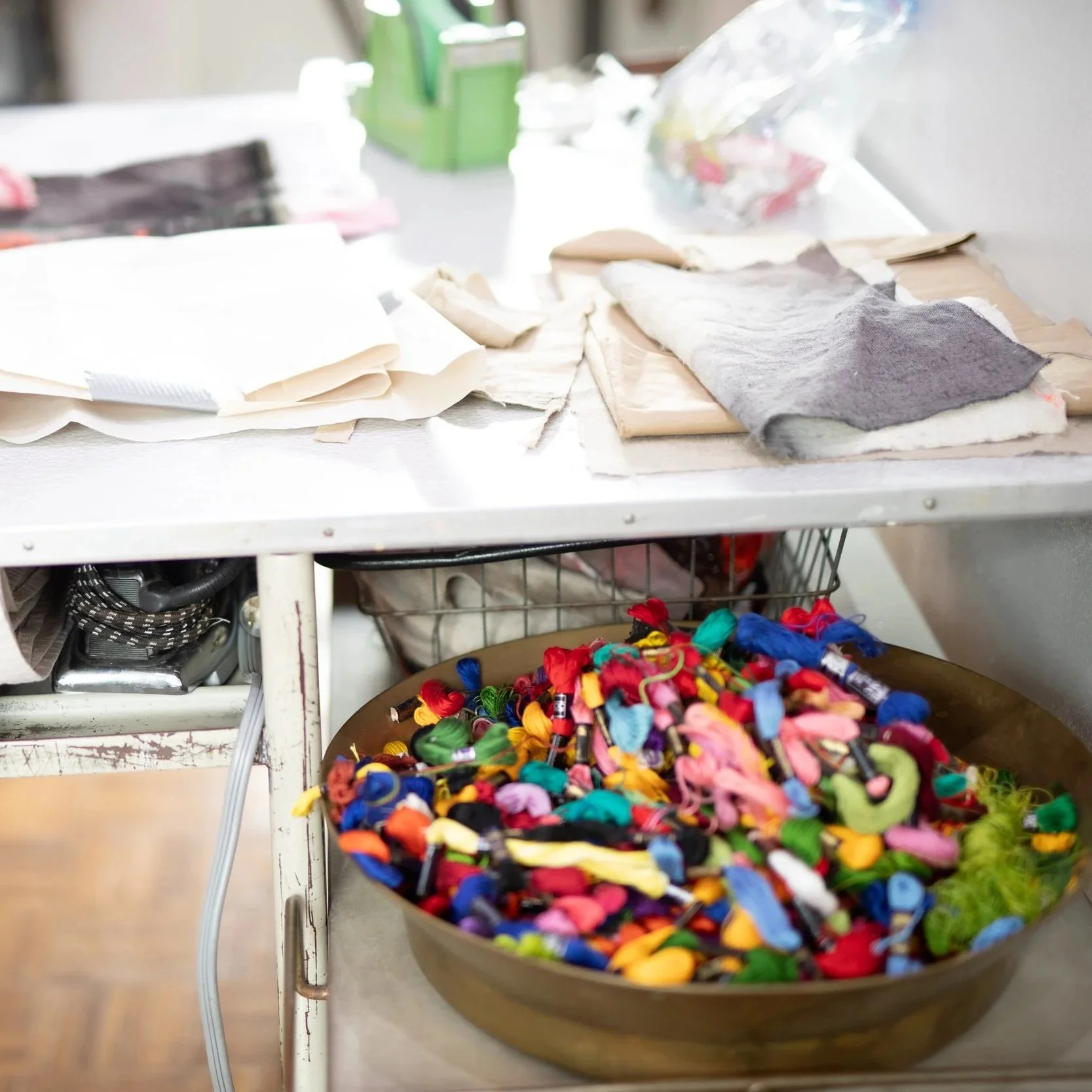
Natalka's studio. Textiles, threads as a colour palette in preparation for a new work. Photo by Zahra Saleki.
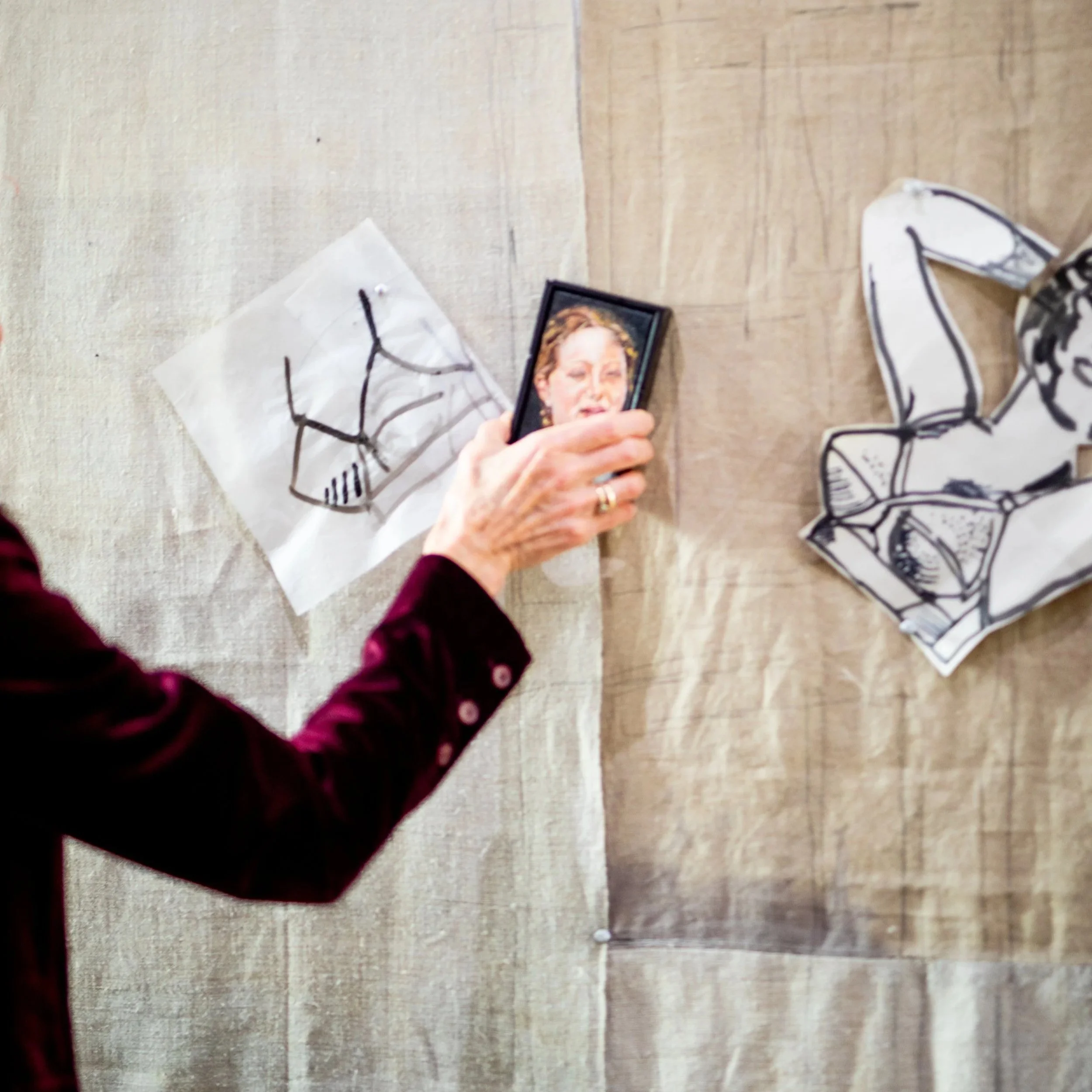
Natalka arranging sketches, fabric scraps, and overlapping textiles as she works out the composition for her next piece. Photo by Zahra Saleki.
In this sense, Husar is a kind of realist. Throughout her paintings seen in her catalogues, Husar uses people as a way of exploring identity, power, and social change. Many of these characters are archetypes, like the Soviet-era Ukrainian woman or the Russified Ukrainian oligarch wannabe, drawn from observations and reimagined through paint. Others recur quietly, like the innocent child sucking her thumb who first appears in Pandora’s Parcel to Ukraine, Пандорина посилка в Україну (1993), but who ages over time. Some are layered with her own self-portrait as a flight attendant or a nurse. Her characters often move from innocence to corruption, not in neat moral arcs but as a record of what happens to real people under the pressures of history.
Long before public conversations about Russian colonialism became widespread, Husar was painting its impact in unapologetic detail, unafraid to voice her observations about culture and diaspora that many preferred not to confront. “So many of the things people are only starting to talk about now — I was painting them in the ’80s and ’90s. The colonial mindset, the distortions, the erasure — it was all there if you looked.” Even when she was encouraged early in her career to downplay explicit references to “Ukrainian” identity in her titles, she refused.
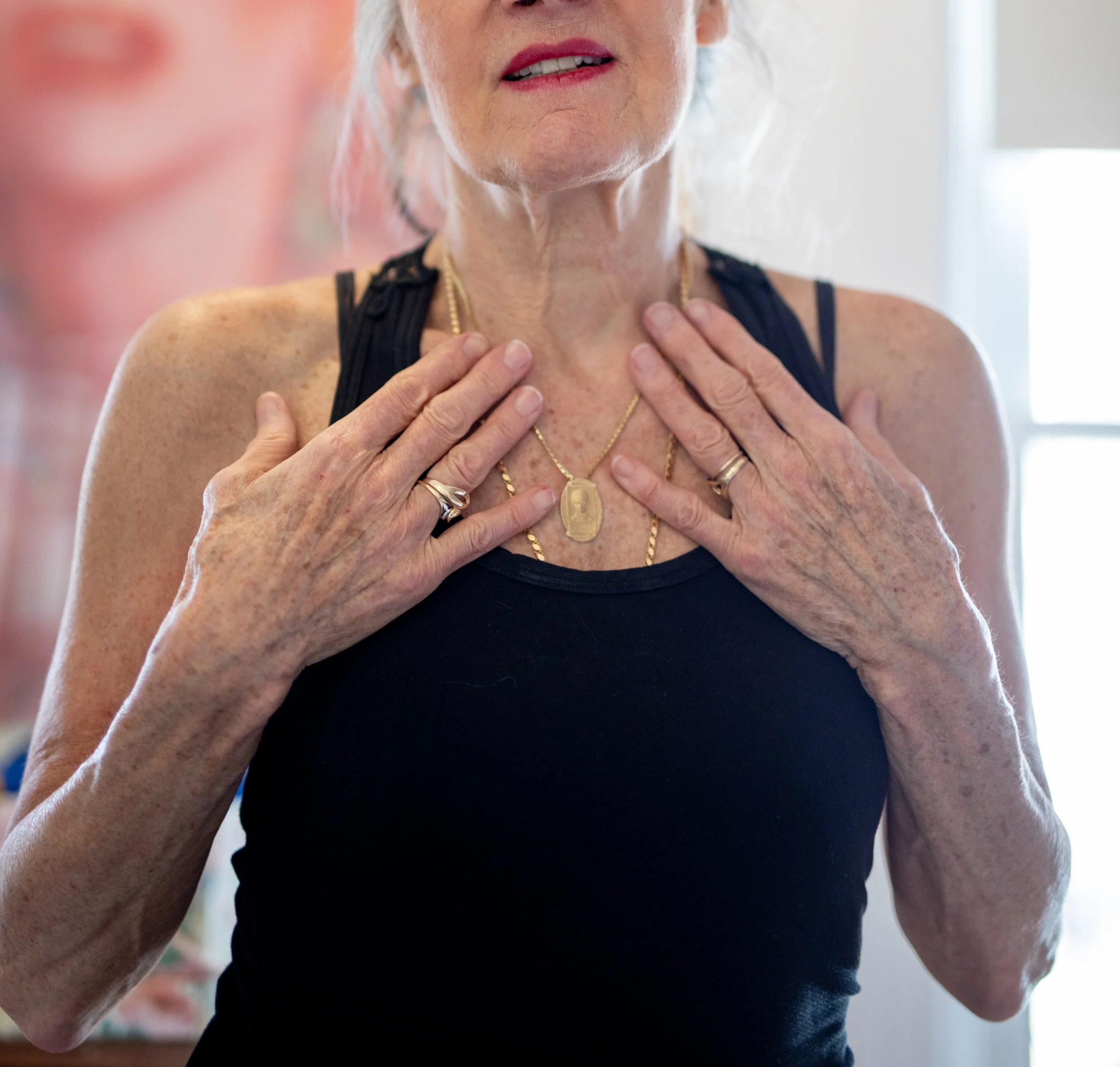
Natalka wears a necklace made by her father, depicting Lesya Ukrainka and inscribed in Ukrainian with the words “fight to the end without mercy.” She has worn it every day since the first day of the full-scale invasion of Ukraine. Photo by Zahra Saleki.
It felt fitting to have this conversation in her home. Husar’s house mirrors her work. Outside, it’s an ordinary red brick Toronto residence; inside, it’s a space layered with Ukrainian and Canadian paintings, antiques, books, and objects that speak to her heritage, her travels, and her life in Canada. “At home, it was Ukrainian. Outside, it was Canadian,” she tells me. “I think that’s why I have this mix in my work — the two realities are always there. You grow up navigating both, and it just becomes natural to work that way.”
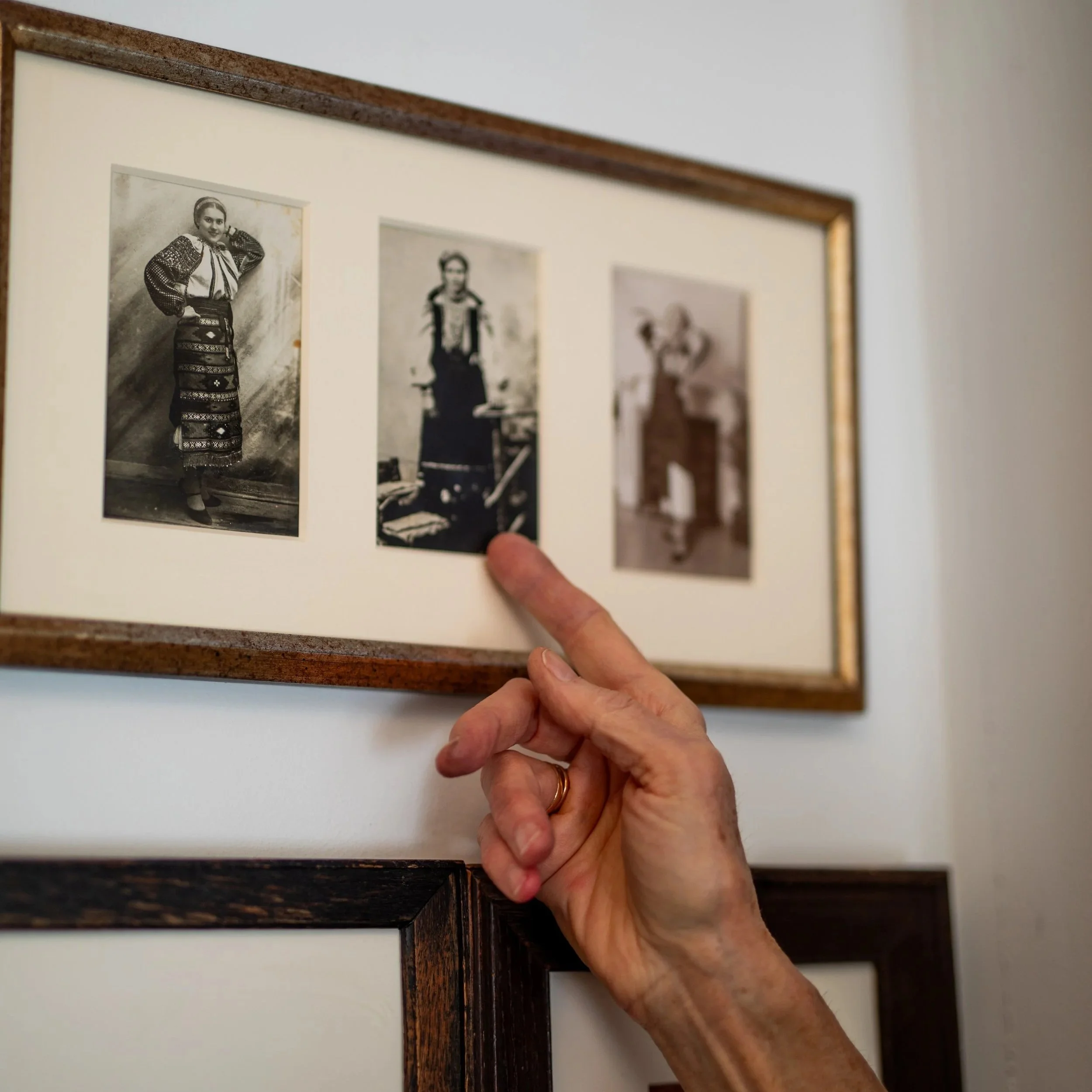
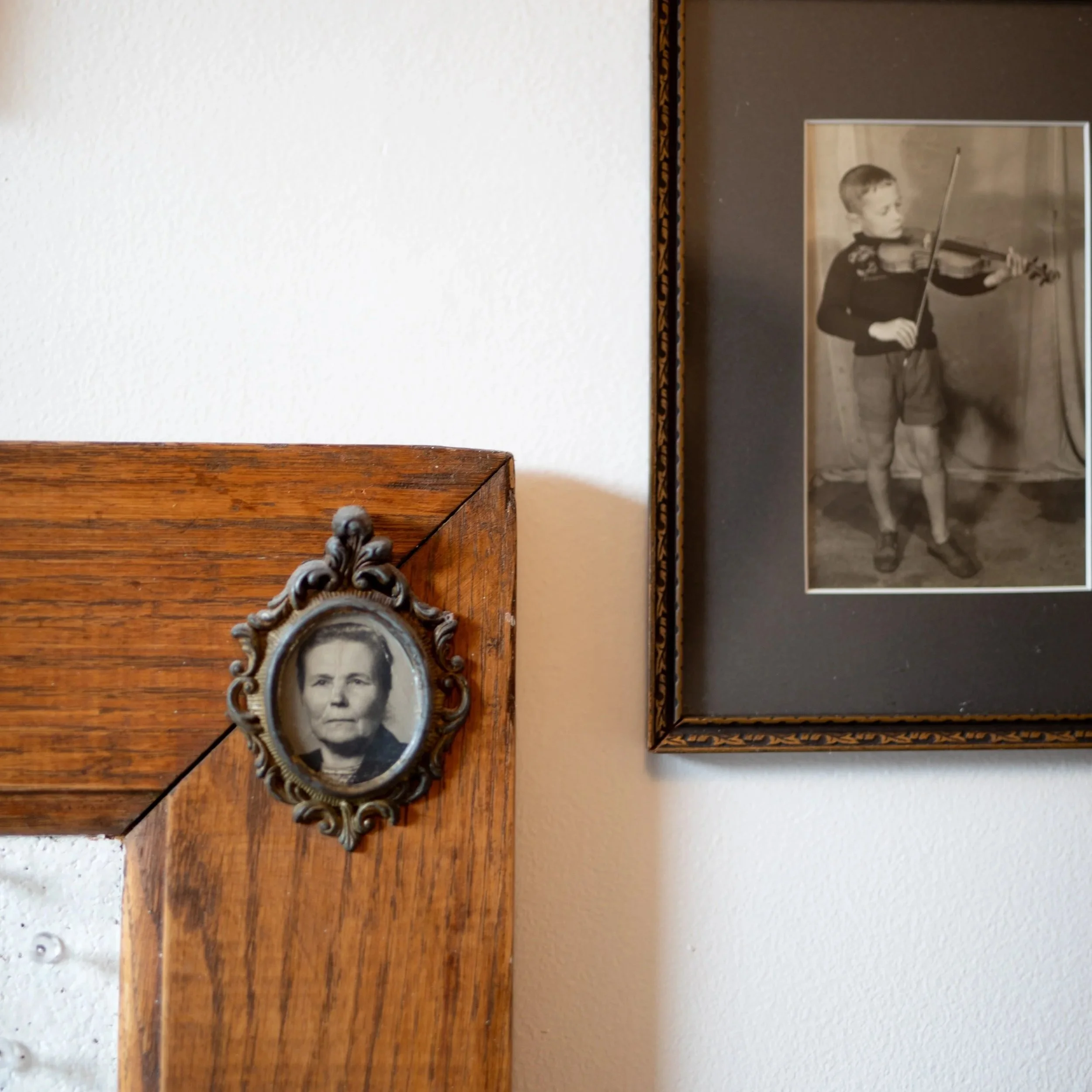
Photos by Zahra Saleki.
Photographer Zahra Saleki moved between us, capturing the artist and her surroundings. Husar didn’t pose in the conventional sense; the photographs captured the natural flow of our conversation, where we’d wandered in the home, and the artworks and personal artefacts at hand. At one point, Husar sat on her silver couch in front of Stop Staring, Крик матраца (1989), a large painting from her True Confessions series, featured in the Fall/Winter 1991–1992 True Confessions catalogue, designed in the style of a gossip magazine. In blue, green, and yellow tones, the work blends interior and exterior space around an overturned mattress, with figures of people and dolls scattered throughout. It is also vividly described in Donna Lypchuk’s essay “The Truth Hurts,” included in that catalogue.
As we moved through the house, Husar shared family photos and stories, especially about her beloved mother. At one point, she cradled a large plaster sculpture of her mother’s head depicted as a sphinx. “That was her wedding present from Mykhailo Chereshnovsky — the same artist who made the monument to Lesya Ukrainka, one of Ukrainian literature’s foremost writers, in High Park,” she said.
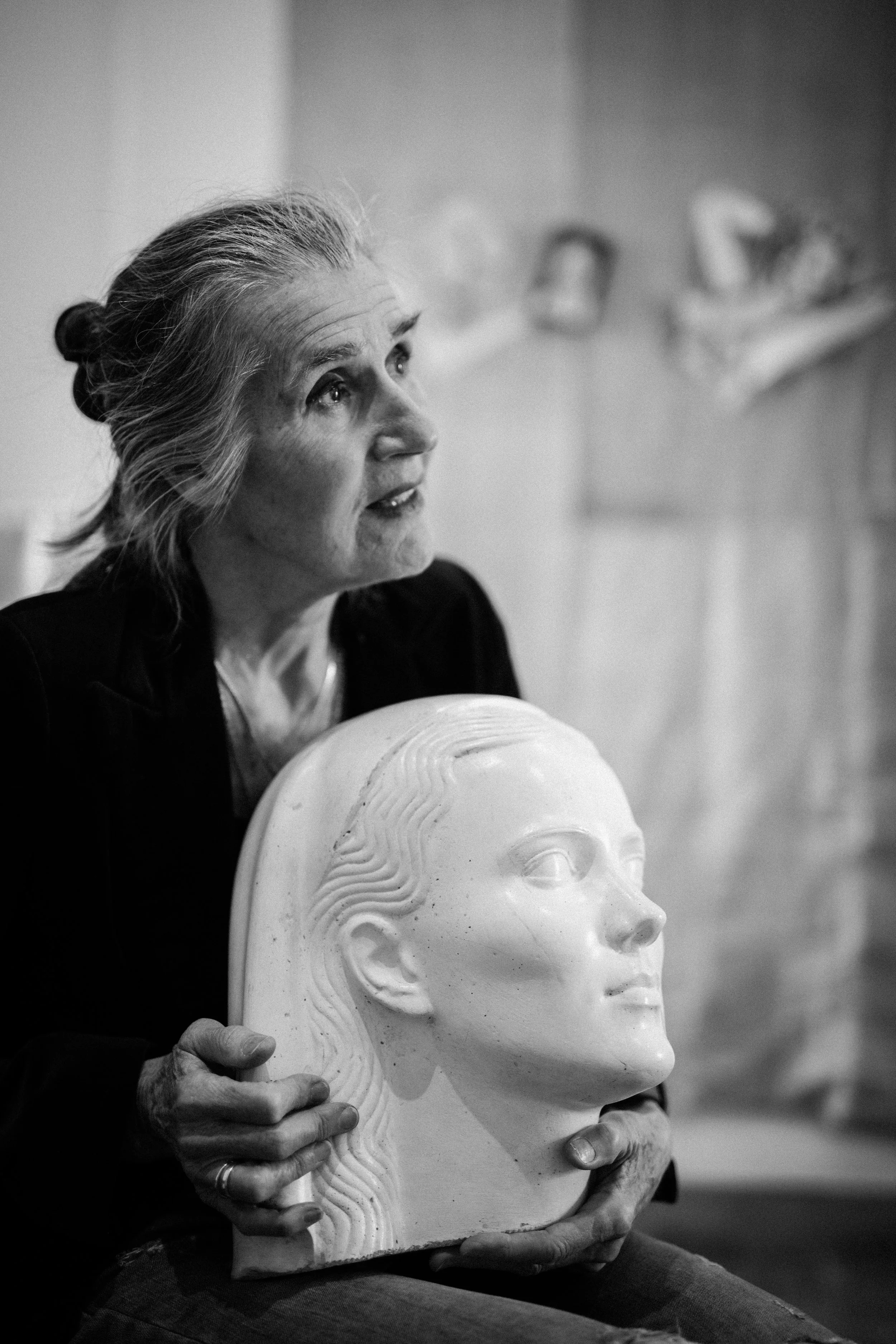
Natalka holding Chereshniovsky's sculpture of Natalka's mother. Photo by Zahra Saleki.
Later, during our conversation at the St. Volodymyr Institute (SVI), we returned to one series in particular: Why They Behave Like Russians. “That is my most important work,” she said without hesitation. Begun in 2005 and included in her Burden of Innocence exhibition, the series is reproduced in Aptechka, a handbound artist book printed in Ukraine through Rodovid Press.
Created nearly a decade before the Revolution of Dignity in 2014, the series speaks to the dynamics that only later entered wider public discussion. At a time when open criticism of Russian colonial influence was still muted, Husar was already visualizing its effects.
The painted portraits in the series depict Ukrainian men dressed like Russian soviet gangsters, painted over book covers from romance novels. Some are rendered as portraits, while others are shown in scenes: men standing beside limousines, prowling disco clubs, brooding in bars, and negotiating shady deals.
In sequence, they carry titles that read like a poem:
Why they behave like Russians
Under False Pretences
The Corporation Boss
guards The Whispering Gate
The King of Spades
blows Smoke into Flame
Dear Barbarian
Dark Confessor
Never (re) Turn Back
The poem appears in both English and Ukrainian in the Aptechka.
The portraits in Why They Behave Like Russians are not abstract figures. They are specific ‘types’ Husar has observed over years of close looking, all caught in the push and pull between complicity and survival. “It’s not fiction,” she said. “Even when the imagery looks surreal,it’s grounded in reality.”
The Burden of Innocence series examines the social and historical forces that shape behaviour in regions long infiltrated by Russia. “It’s been a Russian strategy for over a century — remove Ukrainians, settle Russians in that land. That’s what was done in the ’30s. That’s why Mariupol, Donetsk are Russian-speaking — they were raised there.”
What troubles her most now is how the so-called “rebuilding” of Mariupol is already being used to make it Russian again. “That’s genocide with a paintbrush.”
Our conversation eventually circled back to the catalogues; a completed set is available to view in the SVI Library. These catalogues are not just documentation, but also a living archive, carrying forward the intertwined narratives across her life’s work, Ukraine’s history, and the characters who populate her art. “If you took all my paintings and laid them out,” Husar said, “you could probably put them together chronologically.” Read and seen together, the artworks unfold like vivid dreams: unsettling, layered, and slow to resolve.
“They’ve grown older,” she said, looking at the once innocent child from the 1990s, now carrying the marks of time. “They’ve lived through what Ukraine has lived through.” Across each painting and portrait, you can trace the continuity of her vision, her characters evolving, Ukraine’s story unfolding, and the persistent undercurrents of colonialism, satire, and cultural survival.
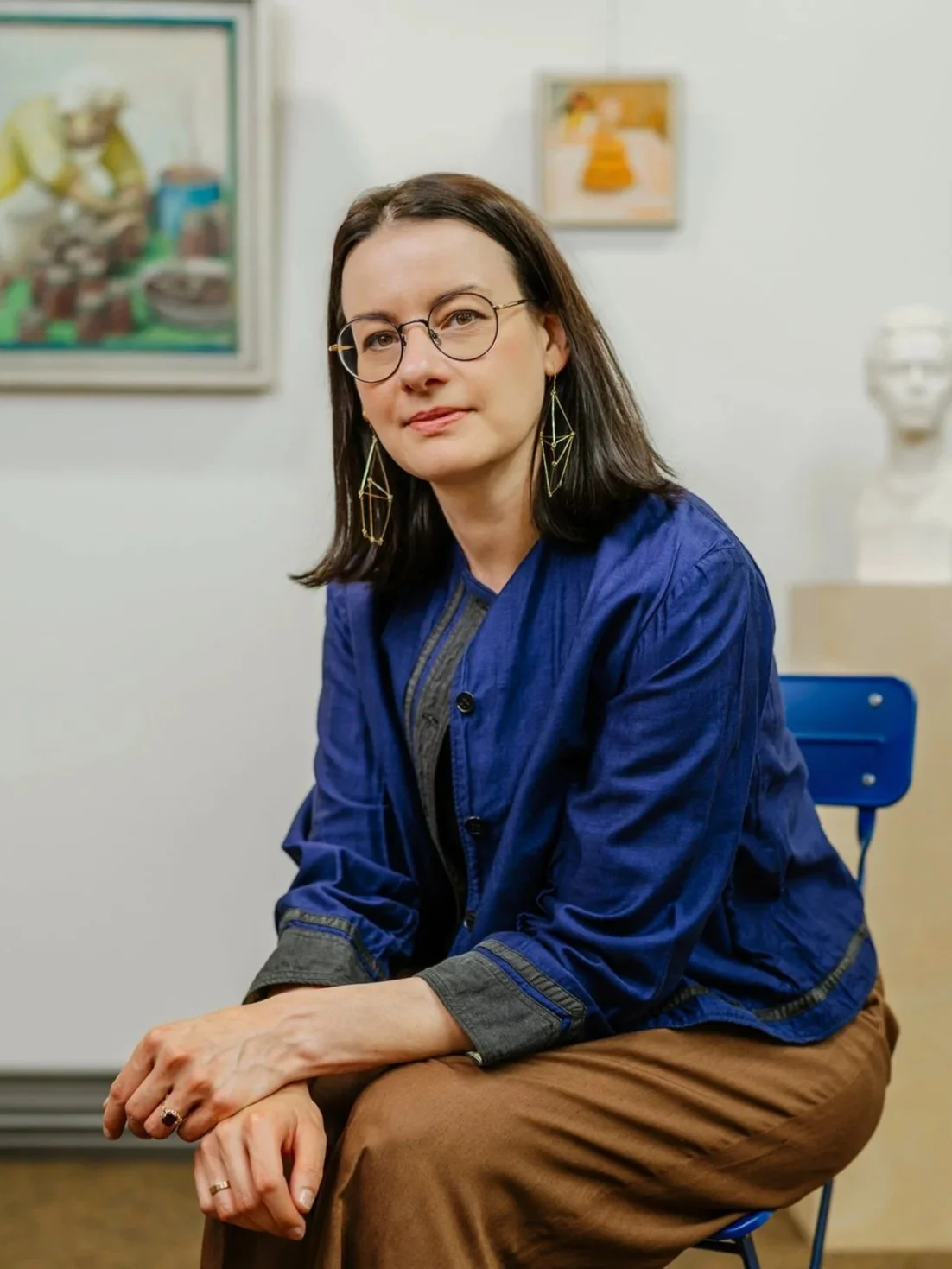
Oksana Hawrylak
Creative Director, SVI
All photographs taken at Natalka Husar's home and studio in Toronto by Zahra Saleki, 2024.
