Yaroslav Barnych: Laughter and Tears in Ukrainian Music History
From the SVI Library
The SVI Library holds a collection of original papers by Ukrainian composer Yaroslav Barnych, best known for the operetta Hutsulka Ksenya. The collection includes handwritten scores, correspondence, explanatory notes, and Barnych’s eyewitness account of the violent interruption of the 1943 première of Sharika in German-occupied Stanyslaviv, now Ivano-Frankivsk.
In this article, historian Thomas M. Prymak examines Barnych’s life, his connections to Ukrainian communities in Canada, and the remarkable archival materials preserved at Saint Volodymyr Institute in Toronto.
Thomas M. Prymak (University of Toronto). Originally published in The New Pathway, June 18, 2026. Republished with permission.
Yaroslav Barnych’s Early Life and Musical Career
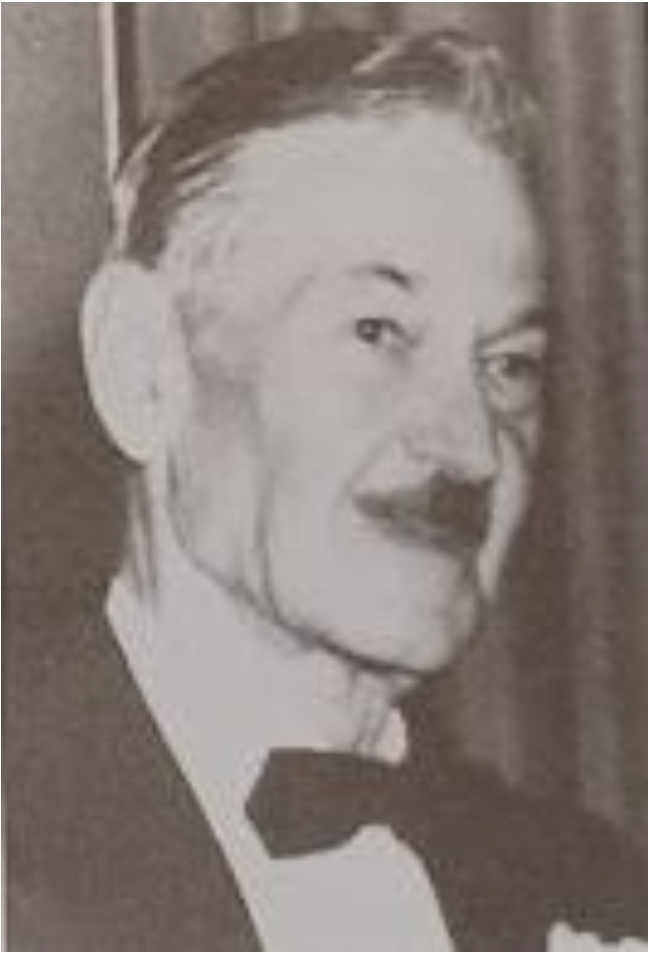
Maestro Yaroslav Barnych, c. 1961. Credit: Ukrainian Music Encyclopedia (Ukrainska muzychna entsyklopediia.)
Yaroslav Barnych (1893-1967) is little known outside the cultural circles of western Ukraine. But in the western Ukrainian town of Ivano-Frankivsk and the area surrounding it, he is almost a folk hero; for this joyfully creative figure was probably the most important among the early Ukrainian composers of operettas. A native of that area, he got his primary education locally but went to Gymnasium (High School) in Vienna, studied music in Lviv, and even spent a whole year doing graduate work in 1920s Berlin. During the First World War, while western Ukraine was still subject to Austria, he joined the Ukrainian voluntary unit called the Sich Riflemen and organized its musical program. He saw battle against the Imperial Russian Army, and with other Western Ukrainians experienced the hopes and dreams of the revolutionary era, the military defeat of the Western Ukrainians by the Poles and the incorporation of their homeland into Interwar Poland.
The 1920s were a period of learning and teaching for Barnych, but by the 1930s, the young musician was in his prime, composing popular songs, operettas, and other works. For a whole year, he taught music and worked for the Prosvita Enlightenment Society in Transcarpathia (while it was still under Hungarian rule) but eventually settled down to teach and work at the Frederic Chopin School, again in Ivano-Frankivsk, then still called Stanyslaviv. He spent the Second World War in Stanyslaviv and after 1943 taught in Lviv. In 1944, as the Soviets approached his Galician hometown, he fled west to Germany, where he lived and composed and, for a short time in Bavaria, directed a choir in a Displaced Persons camp. From 1949, he lived in Cleveland, Ohio, across Lake Erie from Ontario, Canada.
On occasion, Barnych visited Canada, especially nearby Toronto, and was invited to Winnipeg for the historic unveiling of the Taras Shevchenko Monument there in 1961. In the presence of Prime Minister John G. Diefenbaker and Mayor Stephen Juba, both with strong Ukrainian connections (the latter a Ukrainian Canadian), Barnych’s music, especially composed for the occasion, was sung by a 300-voice choir to the strains of a 40-piece orchestra which he directed in coattails. The Premier of Manitoba, Duff Roblin, was there too and announced the re-introduction of the Ukrainian language into the provincial school system. (The language had been banned from Manitoba schools since 1916.) This event was epochal in the history of the Ukrainian Canadians, for thereafter, they clearly felt that they had come of age as a prominent and respected part of Canadian society. Barnych died in 1967.
The composer’s most popular works were, of course, his delightful operettas, and some of his songs became quite popular. After Ukrainian independence in 1991, a few of these became known across all Ukraine. Perhaps his three most important compositions were his romantic comedies of a sort, his “Hutsulka Ksenya,” his “Girl from the Dairy Co-op,” and his “Sharika,” all of them named after the principal female character. These were all typical “operettas,” filled with humour and life, light-hearted spoofs on the much more serious genre of full operas, which more usually end tragically. There now exists a substantial literature on Barnych available to readers in Ukraine. Much less is available in Canada, and there is almost nothing in English, though outlines of his career are present in the most recent general Ukrainian language encyclopedias.
The 1943 Première of Sharika
One day, when I was visiting the SVI Library in Toronto, and the complex and often disputed question of wartime Ukrainian-German relations came up, Anastasia Baczynskyj, the librarian, mentioned to me that the library held an archival box filled with Barnych’s private papers. These were almost all in his own handwriting and contained his brief but startling eyewitness account of the November 14, 1943, première in German-occupied Stanyslaviv of his operetta “Sharika” (Ukr: “The Balloon” or “Girl with the rosy round cheeks,” as the principal heroine was called). He says the director was I. Mendeliuk, the manager one “Yakovliv.”
The theatre was packed for this performance, and the operetta was in full swing when suddenly a group of fully armed German policemen, the Gestapo, invaded the hall. The joyous laughter of the preceding moments was instantly gone when an officer shouted out: “Women and children out! Men, stay!” According to Barnych, this Gestapo unit included an officer named Brandt, who was an infamous Ukraine-hater (ukrainozher) and the Germans shouted out defamatory insults at the Ukrainians. Barnych says that they were looking for young men sympathetic to the Organization of Ukrainian Nationalists (OUN); other testimony states that Soviet partisans were already causing trouble in the area and a time of further turmoil was fast approaching.
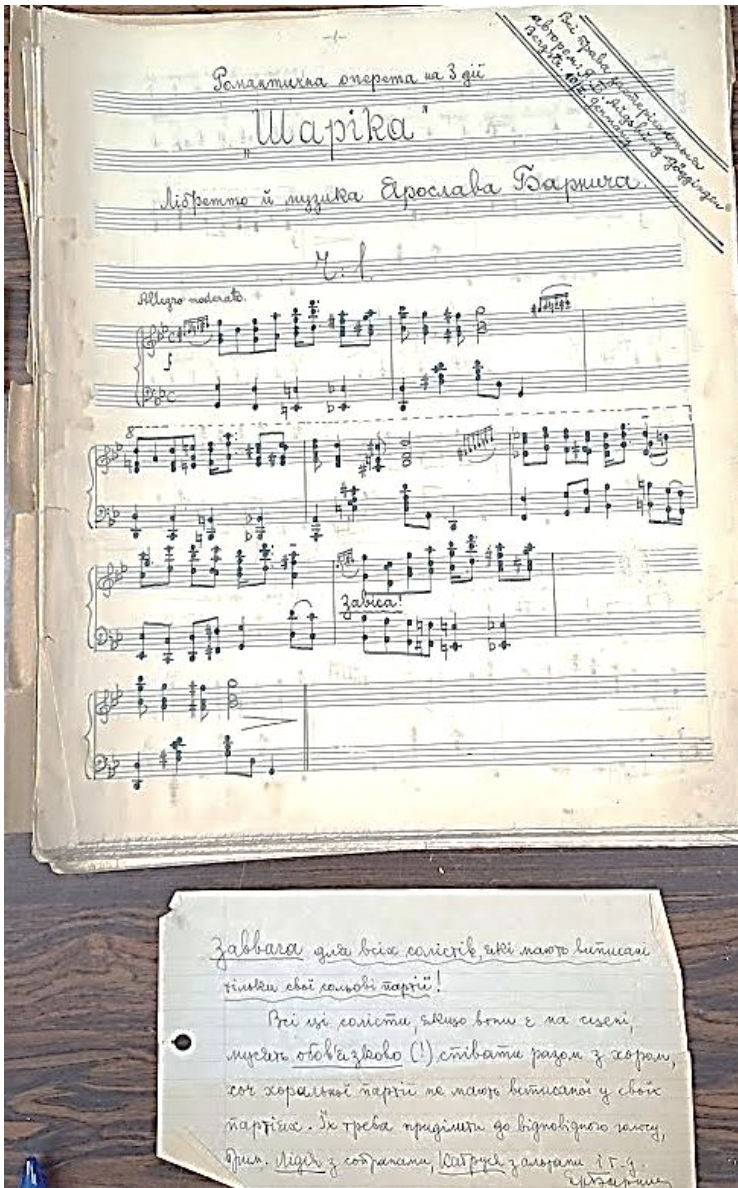
Manuscript of the first page of “Sharika” with explanatory note below and Barnych’s signature at the very bottom. A note across the top right states his legal rights as author of the piece.
Confusion followed, many young men were shot, people were jumping out of the windows to escape, many were arrested, and public executions followed. Barnych testifies that the Gestapo killed about a hundred people; other sources claim about forty died, while still other sources say that some innocents were let out of jail afterwards, though they also claim that two female members of the local liaison Ukrainian Committee were arrested and sent to Auschwitz where it was thought that they perished. Barnych also says that a few months later the theatre director, who carried a German-sounding name, [first initial unclear …] “A. Shtadler” was shot.
Such was the story of the opening of “Sharika” in wartime “Stanyslaviv,” today, Ivano-Frankivsk.
Somehow, Barnych escaped to tell his tale. It is unknown whether he was one of those who jumped out of a window, ran out of another door, was arrested and later set free, or simply explained to the authorities in his seemingly very good German who exactly he was.
The Barnych Papers at the SVI Library
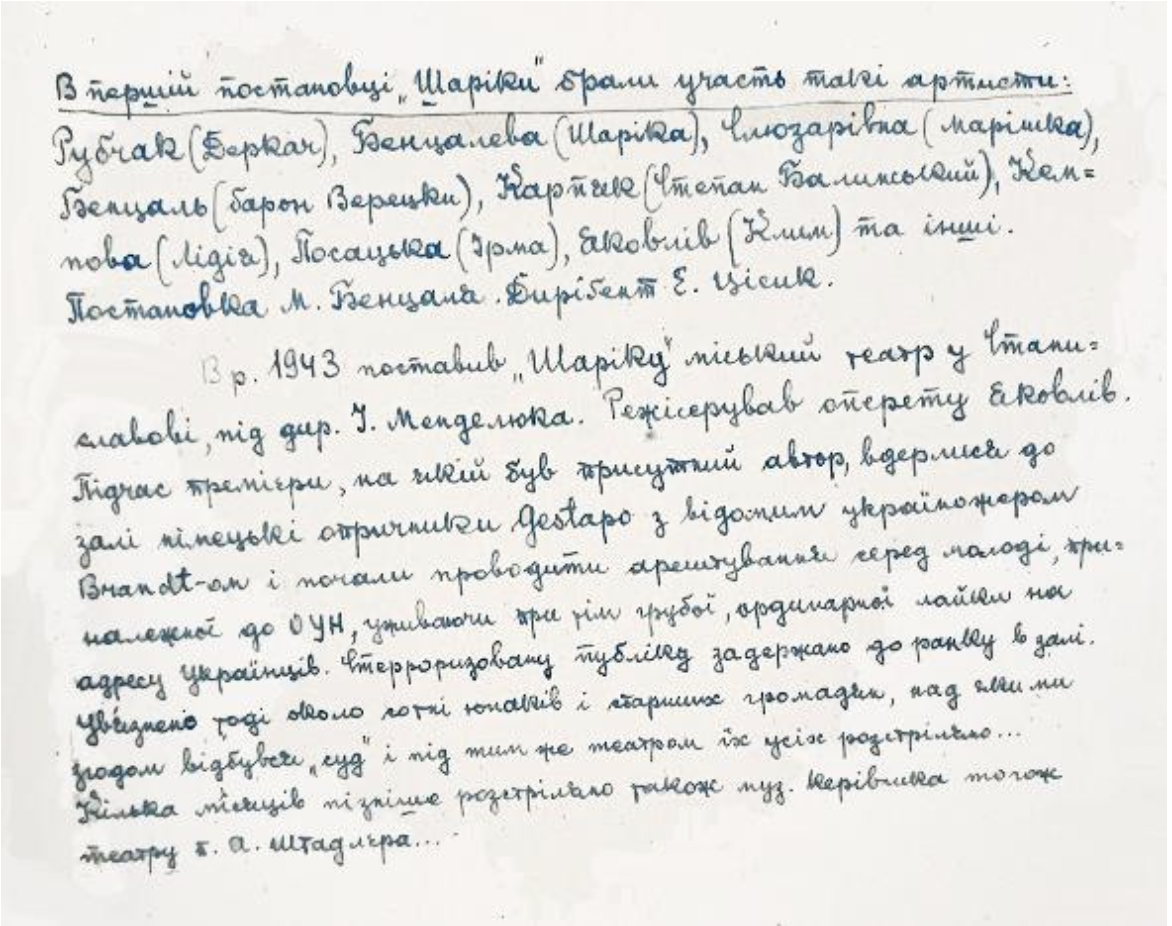
Yaroslav Barnych’s hand-written note about the November 14, 1943, incident at the theatre in Stanyslaviv that appears at the end of the full MS of his “Sharika.” It begins with the names of the actors and actresses and the parts they played and continues with a description of what happened next. Barnych probably wrote it out from memory many years later. This image is photo-shopped from the original for increased clarity, courtesy of the Toronto Ukrainian photographer and film specialist William (Vasyl) Szuch. Scan by Bohdana Panchyshyn.
In addition to this startling testimony about 1943, Barnych’s papers reveal that in the USA, he also retained good relations with Canadians, especially with the Ukrainian National Federation (UNF), which he hoped would fund some of his performances. The texts are written out in his beautifully clear handwriting. In the 1950s, the UNF did publish both “Hutsulka Ksenya” and “Sharika” and the Robarts Library at the University of Toronto holds copies donated by the historian of the “Galicia Division,” Vasyl Veryha, a Robarts librarian and UNF member.
Barnych also proposed to write an operetta, “Divcha v taboru” (A Girl in the Camp), on the subject of the love affair of a Canadian airman with a girl in a DP camp in postwar Germany. But he never finished it. This would have had some true historical background as in the immediate postwar years, RCAF officers (such as the famed Captain Bohdan Panchuk from Saskatchewan) were active in protecting Ukrainian refugees from compulsory repatriation to the USSR. Many such refugees (in Ukrainian then usually called “skytaltsi”) came to Canada.
The SVI Barnych files also contain: a piece written by the Detroit-based Bandurist Chorus leader Hryhory Kytasty with lyrics by Barnych; explanatory notes to various Barnych works; “Baturyn,” an unfinished opera based on the three volume novel by Bohdan Lepky treating the revolt of Hetman Ivan Mazepa (d. 1709); and the handwritten text and score of his 1961 composition for the unveiling of the Shevchenko monument in Canada, for which he was made an “Honorary Citizen of Winnipeg.” In the United States, he was also honoured with a “Golden Baton” for his life work. Both Cardinal J. Slipyj and Pope Paul VI wrote letters of congratulation.
****
How the Collection Came to SVI:
The Barnych papers came to the SVI Library by way of, firstly, the very old library of Toronto’s Ukrainian National Home, which closed down in the 1980s. Some of its holdings were scattered, but most, including the Barnych papers, went on to the UNF Library in Toronto on College Avenue, later Evans Avenue, where they were first discovered by Anastasia Baczynskyj, who at that time was the UNF librarian. When the UNF library was closed, the bulk of its collection was preserved, and in early 2026 Anastasia arranged to have it sent to Ternopil in western Ukraine.
It made the dangerous crossing of the Black Sea, where it was exposed to possible attack by Russian missiles or drones and arrived safely in that town a few weeks later. But the Barnych papers, with much else important and irreplaceable, remained in Toronto, and for safekeeping were deposited in the SVI Library, where they are currently available for viewing and use by visitors and researchers.
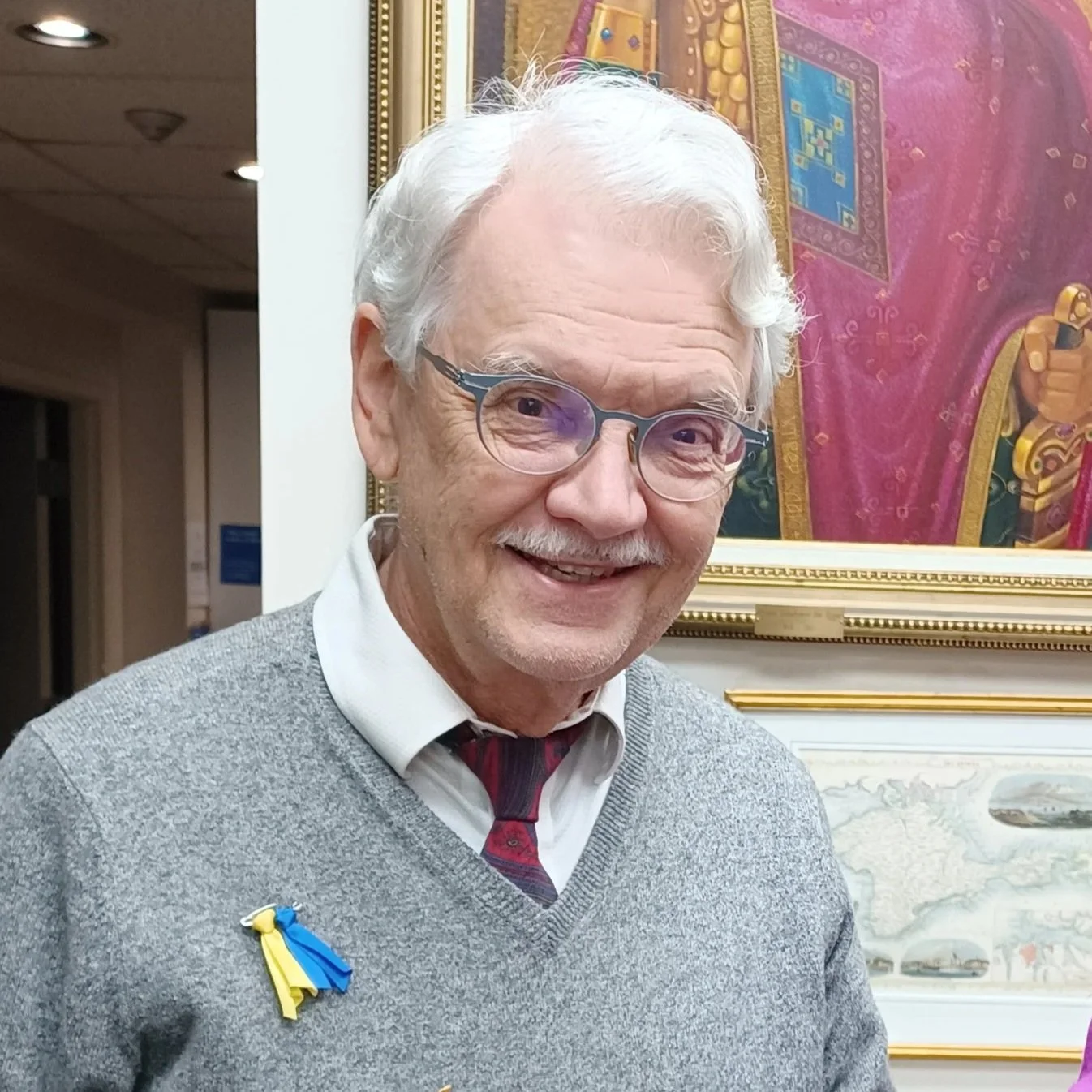
Thomas M. Prymak, PhD, is a historian, writer, and private scholar who previously served as a Senior Research Fellow at the University of Toronto’s Chair of Ukrainian Studies. His work focuses on Ukrainian political and cultural history, often through a biographical lens. His research has received recognition from the Ukrainian Historical Association, and his book Ukraine, the Middle East, and the West was a finalist for the Peterson Literary Prize.
Explore the Yaroslav Barnych Collection and more
The Yaroslav Barnych papers and many other significant archival documents are preserved in the SVI Library in Toronto and are available to visitors and researchers. To learn more about the collection, arrange a research visit, or contact us, visit the SVI Library page.
Interested in helping preserve Ukrainian-Canadian cultural history? Support the SVI Library.